Kjar, A.; Haschert, M.R.; Zepeda, J.C.; Simmons, A.J.; Yates, A.; Chavarria, D.; Fernandez, M.; Robertson, G.; Abdulrahman, A.M.; Kim, H.; Marguerite, N.T.; Moen, R.K.; Drake, L.E.; Curry, C.W.; O’Grady, B.J.; Gama, V.; Lau, K.S.; Grueter, B.; Brunger, J.M.; Lippmann, E.S. Cell Reports, Volume 43, Issue 11, 2024, Article 114874, 听
听
Human neural organoids are used to study brain biology, but making them more accurate in representing different types of brain cells is still a challenge. In this study, the researchers compared two materials for growing these organoids: Matrigel (a common material) and a new material called GelMA-Cad, which is made from a special gel that helps guide cell development. They found that the GelMA-Cad material helped the organoids develop more like human fetal brain tissue and produced neurons that were more active compared to those grown in Matrigel.听
These findings suggest that GelMA-Cad could be a better material for growing neural organoids, allowing researchers to control how the cells develop more precisely. It also offers a simpler and more reliable alternative to Matrigel for research on brain development.听
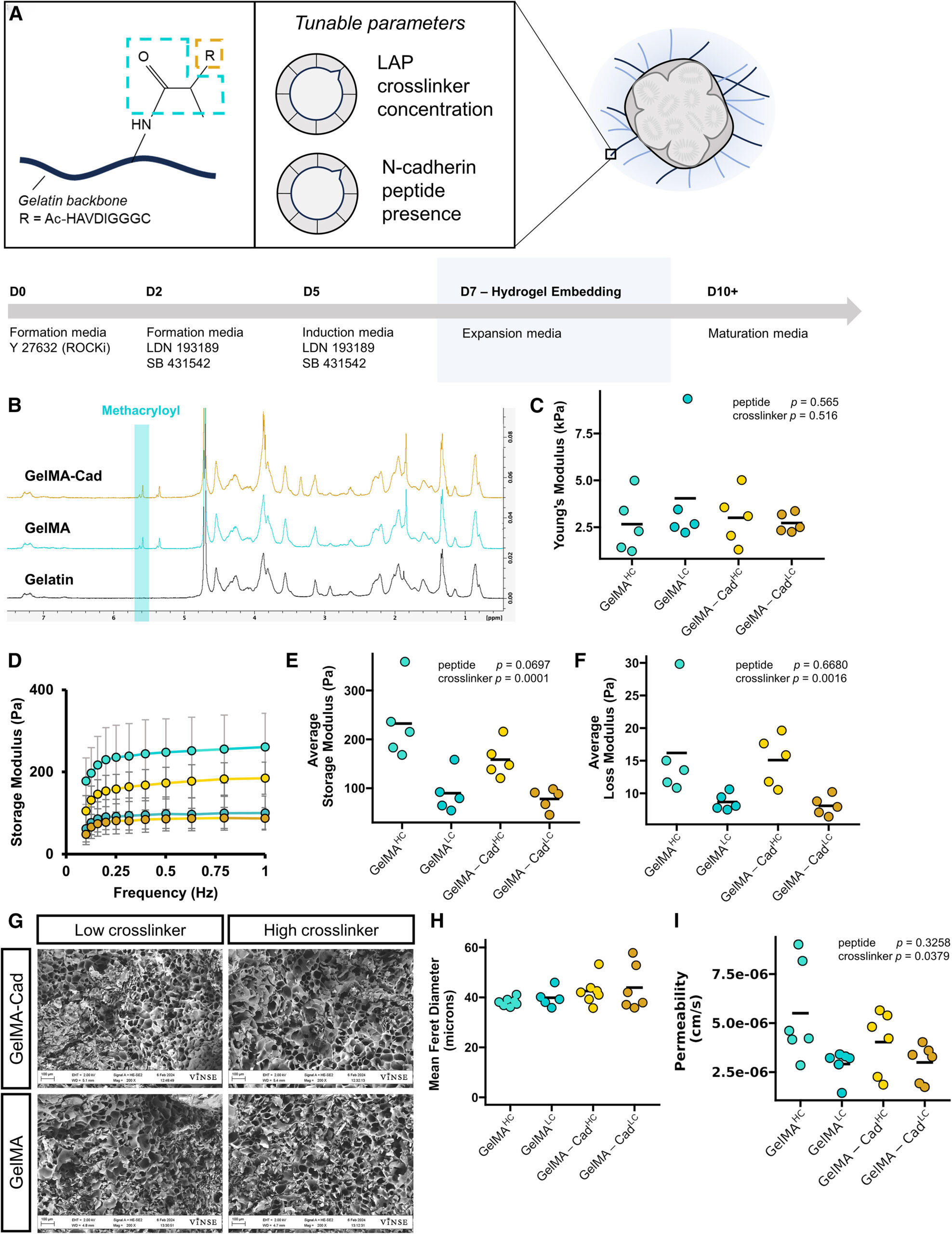
Figure听1.听Functionalized gelatin matrix parameters for cortical organoid culture听
(A) Schematic of GelMA-Cad, major tunable parameters, and associated organoid culture timeline. GelMA-Cad utilizes a gelatin-based backbone, with a conjugated methacryloyl group (blue), allowing photo-initiated crosslinking. The methacryloyl can be further modified by the addition of an N-cadherin (Cad) peptide mimetic (orange). Adjusted parameters include the LAP crosslinker concentration and N-cadherin peptide presence.听
(B) Representative听1H-NMR spectra of gelatin, GelMA, and GelMA-Cad displaying the characteristic peaks associated with methacryloyl.听
(C) Atomic force microscope characterization of Young鈥檚 modulus.听N听= 5 measurements, each the average of 512 technical replicates. Bars represent data mean. Statistical significance was calculated with a two-way ANOVA, modeled on crosslinker concentration and peptide presence.听
(D) Average storage modulus traces from GelMA and GelMA-Cad hydrogels.听N听= 5 measurements, error bars represent the standard deviation.听
(E) Rheological characterization of average storage modulus across tested frequencies.听N听= 5 measurements, bar represents data mean. Statistical significance was calculated with a two-way ANOVA, modeled on crosslinker concentration and peptide presence.听
(F) Rheological characterization of average loss modulus across tested frequencies.听N听= 5 measurements, bar represents data mean. Statistical significance was calculated with a two-way ANOVA, modeled on crosslinker concentration and peptide presence.听
(G) Representative scanning electron micrographs of lyophilized, crosslinked hydrogels. Scale bar: 100听渭m.听
(H) Quantification of pore size from scanning electron micrographs. Each point is the mean of measurements made from a single image,听N听= 6鈥�7 images per condition, each image from a separate preparation. Bars represent data mean.听
(I) Apparent permeability coefficient of 3听kDa FITC-dextran in each hydrogel.听N听= 6 measurements, bar represents data mean. Statistical significance was calculated with a two-way ANOVA, modeled on crosslinker concentration and peptide presence.听