Ekle, Ocheme Anthony; Eberle, William; Christopher, Jared. “” Applied Sciences (Switzerland) 15, no. 6 (2025): 3360. .听
Detecting unusual behavior in large, constantly changing networks鈥攍ike catching hackers in action, spotting fake news, or identifying suspicious bank transactions鈥攊s extremely important. But many current tools that analyze these networks are based on fixed snapshots, which makes them less effective when things change quickly.听
This study introduces听Adaptive-DecayRank, a new method that can spot strange or unexpected patterns in real time, even as the network evolves. It builds on a well-known technique called PageRank (which Google uses to rank websites) but makes it smarter by letting each part of the network adjust how quickly it “forgets” past activity, based on what鈥檚 happening now. This helps the system quickly recognize sudden changes in the structure of the network鈥攍ike a burst of unusual connections or suspicious activity.听
The researchers tested this new method on several real-world cybersecurity datasets, including ones from the U.S. government and university research projects, and also on complex simulated networks. The results showed that听Adaptive-DecayRank听was significantly better at detecting anomalies compared to other leading tools, catching more threats with greater accuracy鈥攅ven in fast-changing environments.听
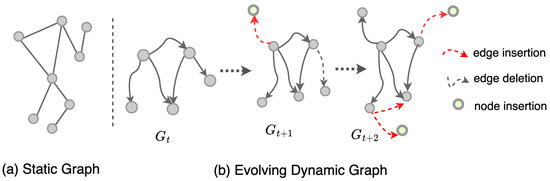
Figure 1.听An illustraction of graph representation: (a) Static graph,听G, and (b) evolving dynamic graph,听饾挗=(饾憠饾憽,饾惛饾憽,饾挴), showing a series of graph snapshots with edge insertions, deletions, and node insertions over time.听