Lu, Ming; Wang, Ruilin; Chen, Yuanyuan; Li, Rangsong; Yang, Xiaoyue; Liang, Hao; Zhu, Haoqin; Yan, Xinqiang. “” Medical Physics (2025). .听
Magnetic resonance imaging (MRI) is a powerful and non-invasive way to look inside the body, especially useful for examining soft tissues like the brain or muscles. One of the key factors in producing clear MRI images is the signal-to-noise ratio (SNR)鈥攖he higher the SNR, the better the image quality. To improve SNR, doctors sometimes use special materials, like pads or advanced inserts, placed between the body and the MRI machine. However, these methods can cause problems, such as interfering with the radio waves used by the MRI and raising safety concerns.听
This study introduces a new solution to improve MRI image quality: a wireless device called a 鈥渓adder resonator.鈥� Unlike other inserts, this device is designed to enhance image clarity without disrupting the MRI machine鈥檚 signals. Researchers used computer simulations to design and test different versions of the ladder resonator, trying models with 4, 6, 8, and 10 鈥渞ungs.鈥� They found that the 8-rung version worked best, so they built it and tested it in both lab conditions and with real human volunteers using a common hospital MRI scanner.听
The results showed that the 8-rung ladder resonator significantly improved the image quality, with up to 4.7 times better SNR in head scans compared to using the MRI machine alone. It also outperformed traditional single-loop devices used for the same purpose.听
Overall, this new ladder resonator design has the potential to make MRI scans clearer and more accurate. It鈥檚 safe, easy to use, affordable, and works with existing MRI machines, making it a promising tool for regular clinical use.听
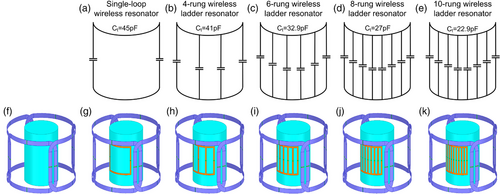
FIGURE 1听
(a鈥揵) Circuit diagrams of a single-loop wireless resonator (a), 4-rung (b), 6-rung (c), 8-rung (d), and 10-rung (e) wireless ladder resonators (c). (f) Simulation model of a 4-channel local receive array alone. (g鈥搆) Simulation models of the 4-channel array with a single-loop wireless resonator (g), 4-rung (h), 6-rung (i), 8-rung, (j) and 10-rung (k) wireless ladder resonators. A pair of double pick-up sniffers was placed 2听cm above the coils to detect resonant peaks.听