Huffman, Jennifer E., Gaziano, Liam., Al Sayed, Zeina Reda., Judy, Renae L., Raffield, Laura Marie., Biddinger, Kiran J., Charest, Brian R., Chopra, Anant., Gagnon, David R., Guo, Xiuqing., Koledova, Vera V., Levin, Michael G., Min, Yuan I. Nancy., Pirruccello, James P., Reza, Nosheen., Ruan, Richard., Verma, Shefali Setia., Verma, Anurag., Yao, Jie., Carr, John Jeffrey., Casas, Juan Pablo., Cho, Kelly M., Lima, Jo茫o A.C., Post, Wendy S., Rader, Daniel J., Ritchie, Marylyn D., Shah, Amil M., Taylor, Kent D., Terry, James G., Rich, Stephen S., O鈥睤onnell, Christopher J., Phillips, Lawrence S., Lunetta, Kathryn L., Rotter, Jerome I., Wilson, Peter W.F., Gaziano, John Michael M., Damrauer, Scott M., Kranzler, Henry R., Hung, Adrianna M., Assimes, Themistocles L., Whitbourne, Stacey B., Stephens, Brady M., Shayan, Shahpoor (Alex)., Ringer, Robert J., Pyarajan, Saiju., DuVall, Scott L., Churby, Lori L., Brophy, Mary Therese., Brewer, Jessica V.V., Oslin, David W., Matheny, Michael Edwin., Hauser, Elizabeth R., Tsao, Phillip Shih Chung., Deen, Jennifer E., Moser, Jennifer., Muralidhar, Sumitra., Sun, Yan V., Ellinor, Patrick T., Joseph, Jacob., Aragam, Krishna G. (2025).听.听Nature Genetics,听57(11), 2682-2690.听
Scientists have long known that聽dilated cardiomyopathy (DCM)鈥攁 condition where the heart becomes enlarged and weak鈥攁ffects people of African descent at much higher rates, but the reasons for this have not been fully understood. In this study, researchers looked for a genetic explanation by analyzing DNA from聽1,802 people with DCM听补苍诲听93,804 people without the disease, all with聽African genetic ancestry (AFR).
They found a strong link between DCM and a specific genetic change in the聽CD36聽gene, called聽rs3211938:G. This is a聽nonsense variant, meaning it turns the gene 鈥渙ff.鈥� The variant is relatively common in people of African ancestry鈥攆ound in about聽17%鈥攂ut is extremely rare in people of European ancestry (less than 0.1%). People who inherit two copies of this variant (about聽1%聽of the AFR population) have roughly聽three times higher odds聽of developing DCM. Even among people who have no diagnosed heart disease, those with two copies of the variant show weaker heart function, with an聽8% lower left ventricular ejection fraction, a key measure of how well the heart pumps blood.
In people of African ancestry, this single CD36 variant accounts for聽8.1% of total DCM cases聽and explains about聽20% of the excess risk聽of DCM compared with people of European ancestry.
Laboratory experiments using human heart cells grown from stem cells showed that losing CD36 function disrupts the heart cells鈥� ability to take up fatty acids鈥攁n important energy source. This leads to problems in cellular metabolism and reduces how effectively the cells can contract. Together, these findings suggest that聽loss of CD36 function and impaired heart energy use are major contributors to DCM in people of African descent.
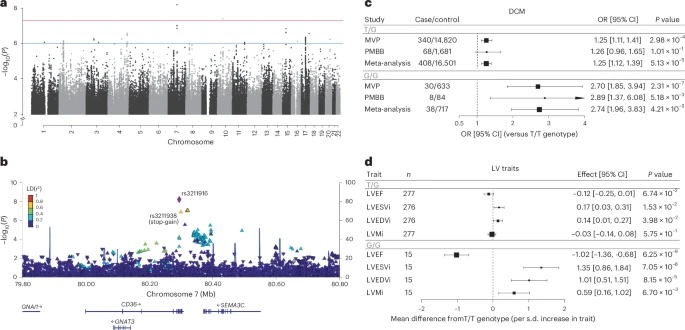
Fig. 1: Association of聽CD36聽locus with DCM and validation of聽聽in left ventricular phenotypes among AFR individuals.
a, Manhattan plot showing the association between common genetic variants and DCM across the genome in AFR individuals.听b, Regional association plot of the聽CD36聽locus, displaying variant-level associations and linkage disequilibrium with the lead SNP () based on the 1000 Genomes AFR population.听c, Association of heterozygous (T/G) and homozygous (G/G)聽genotypes with DCM (versus the reference genotype (T/T)) in African ancestry participants of the VA MVP and PMBB, estimated using logistic regression adjusted for age, sex and the first ten principal components. Data are shown as ORs with 95% CIs.听d, Associations of聽genotypes with cardiac MRI-derived left ventricular traits in African ancestry participants from the UKB, MESA and JHS. Associations were estimated using linear regression adjusted for age, sex and the first ten principal components. Data are presented as the mean difference relative to T/T homozygotes (per s.d. increase in trait) with 95% CIs. Only the meta-analysis results are shown; full results are provided in Supplementary Fig.听. LVESVi, left ventricular end-systolic volume indexed for body surface area; LVEDVi, left ventricular end-diastolic volume indexed for body surface area; LVMi, left ventricular mass indexed for body surface area.