Zhu, Guodong., Hong, Ikjun., Li, Kewei., Anyika, Theodore., Ugwu, Maxwell T., Nolen, Joshua Ryan., He, Mingze., Caldwell, Joshua David., & Ndukaife C, Justus C. (2025).听.听Advanced Optical Materials. Advance online publication.听
惭别迟补濒-产补蝉别诲听thermal metasurfaces聽are special materials designed to control how heat is emitted as light. Unlike traditional materials鈥攕uch as gray-bodies, near鈥揵lack bodies, or some dielectric metasurfaces鈥攖hese metal-based structures keep their emission patterns stable even when temperatures change. However, they often have a major drawback: they lose a lot of energy internally through聽ohmic losses, which limits their聽quality (Q) factor, a measure of how sharp and selective their emission is.
This study focuses on solving that problem by finding a way to achieve both聽high emissivity聽(how effectively a material emits thermal radiation) and聽high Q factors聽in metal-based thermal emitters. The researchers use a design strategy that combines聽three surface lattice resonances. These resonances support special physical effects called聽bound states in the continuum听补苍诲听electromagnetically induced absorption (EIA), which together allow the structure to emit light very efficiently and at very specific wavelengths.
Using simulations, the team designed a metal-based metasurface that achieves聽near-unity emissivity (0.96)聽and a聽Q factor of 320. Experiments confirmed strong performance, showing an聽emissivity of 0.82聽and a聽Q factor of 202鈥攁产辞耻迟听five times better聽than the best previously reported metal-based thermal metasurfaces.
Overall, this work demonstrates a promising way to create聽efficient, narrow-band, and directional thermal emitters that maintain stable performance even across large temperature changes.
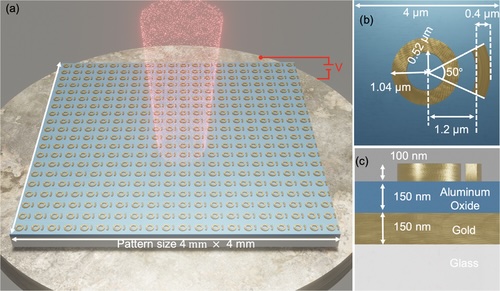
Figure 1
Schematic of the metal-insulator-metal (MIM) configuration used in the study. a) shows the schematic of the thermal metasurface for narrowband directional thermal emission. b) shows the top view of a unit cell of the metasurface comprising a complete circular gold ring and a segmented gold ring. c) shows the side view of a unit cell. A 150 nm gold reflector is thick enough to prevent optical transmission, and a 150 nm aluminum oxide spacer is used to maximize the emission.