Z煤niga-Fern谩ndez, Sebastian., Pozuelos, Francisco J., Devora-Pajares, Mart铆n., Cuello, Nicolas., Greklek-McKeon, Michael., Stassun, Keivan Guadalupe., van Grootel, Val茅rie., Rojas-Ayala, B谩rbara., Korth, Judith., G眉nther, Maximilian N., Burgasser, Adam J., Hsu, Chihchun., Rackham, Benjamin V., Barkaoui, Khalid., Timmermans, Mathilde., Cadieux, Charles., Alonso, Roi., Strakhov, Ivan A., Howell, Steve B., Littlefield, Colin., Furlan, Elise., Amado, Pedro J., Jenkins, Jon M., Twicken, Joseph D., Sucerquia, Mario., Davis, Yasmin T., Schanche, Nicole E., Collins, Karen A., Burdanov, Artem Yu., Davoudi, Fatemeh., Demory, Brice Olivier., Delrez, Laetitia., Dransfield, Georgina., Ducrot, Elsa., Garc铆a, Lionel J., Gillon, Micha毛l., G贸mez Maqueo Chew, Y. G贸mez Maqueo., Jan贸-Mu帽oz, Cl脿udia., Jehin, Emmanu毛l., Murray, Catriona Anne., Niraula, Prajwal., Pedersen, Peter Pihlmann., Queloz, Didier., Rebolo-Lopez, Rafael., Scott, Madison G., Sebastian, Daniel., Hooton, Matthew J., Thompson, Samantha J., Triaud, Amaury H.M.J., de Wit, Julien., Ghachoui, Mourad., Benkhaldoun, Z., Doyon, Ren茅 Crossed Dsign漏., Lafreni猫re, David., Casanova, V铆ctor M., Sota, Alfredo., Plauchu-Frayn, Ilse., Khandelwal, Akanksha., Zong Lang, Francis., Schroffenegger, Urs., Wampfler, Susanne F., Lendl, Monika A., Schwarz, Richard P., Murgas, Felipe., Palle麓, Enric B., & Parviainen, Hannu. (2025).听.听Astronomy and Astrophysics,听702, A85.听
We report the discovery of two 鈥渨arm鈥� exoplanets orbiting a very tight pair of small, cool stars called TOI-2267. This binary system consists of an M5 star (TOI-2267A) and an M6 star (TOI-2267B) that appear extremely close together in the sky鈥攐nly 0.384 arcseconds apart鈥攚hich corresponds to a physical separation of about 8 astronomical units. The system is located just 22 parsecs from our Solar System. To confirm that the signals we detected were truly planets, we combined data from NASA鈥檚 Transiting Exoplanet Survey Satellite (TESS) with ground-based observations, high-resolution imaging, archival measurements, and statistical validation techniques.
Based on the available data, we cannot yet tell for certain which of the two stars the planets actually orbit. If the planets orbit TOI-2267A, they are close to Earth-sized, with radii of 1.00卤0.11 and 1.14卤0.13 Earth radii for TOI-2267 b (which orbits every 2.28 days) and TOI-2267 c (which orbits every 3.49 days). If they instead orbit TOI-2267B, their radii would be slightly larger due to the star鈥檚 dimmer brightness, at 1.22卤0.29 and 1.36卤0.33 Earth radii.
TESS data also show a third, strong periodic signal at 2.03 days, labeled TOI-2267.02. Statistical analysis suggests this signal is also likely caused by a planet, but follow-up observations from the ground did not detect it, so it remains a 鈥減lanetary candidate.鈥� Its radius would be roughly Earth-sized鈥�0.95卤0.12 or 1.13卤0.30 Earth radii鈥攄epending on whether it orbits star A or B.
If the candidate is confirmed, orbital dynamics show that all three planets cannot orbit the same star without becoming unstable. The most likely arrangements are that planets b and c orbit one star while .02 orbits the other, or that .02 and c orbit the same star while b orbits the other. A configuration where .02 and b orbit the same star appears unstable. The fact that planets b and c lie close to a 3:2 mean-motion resonance (meaning their orbital periods are in a nearly perfect 3:2 ratio) also suggests they orbit the same star, with .02 around the other.
If this scenario is correct, TOI-2267 would be the most compact binary system known to host planets around聽both聽stars. This makes it a rare and valuable system for understanding how planets form and evolve in environments where two stars orbit extremely close together.
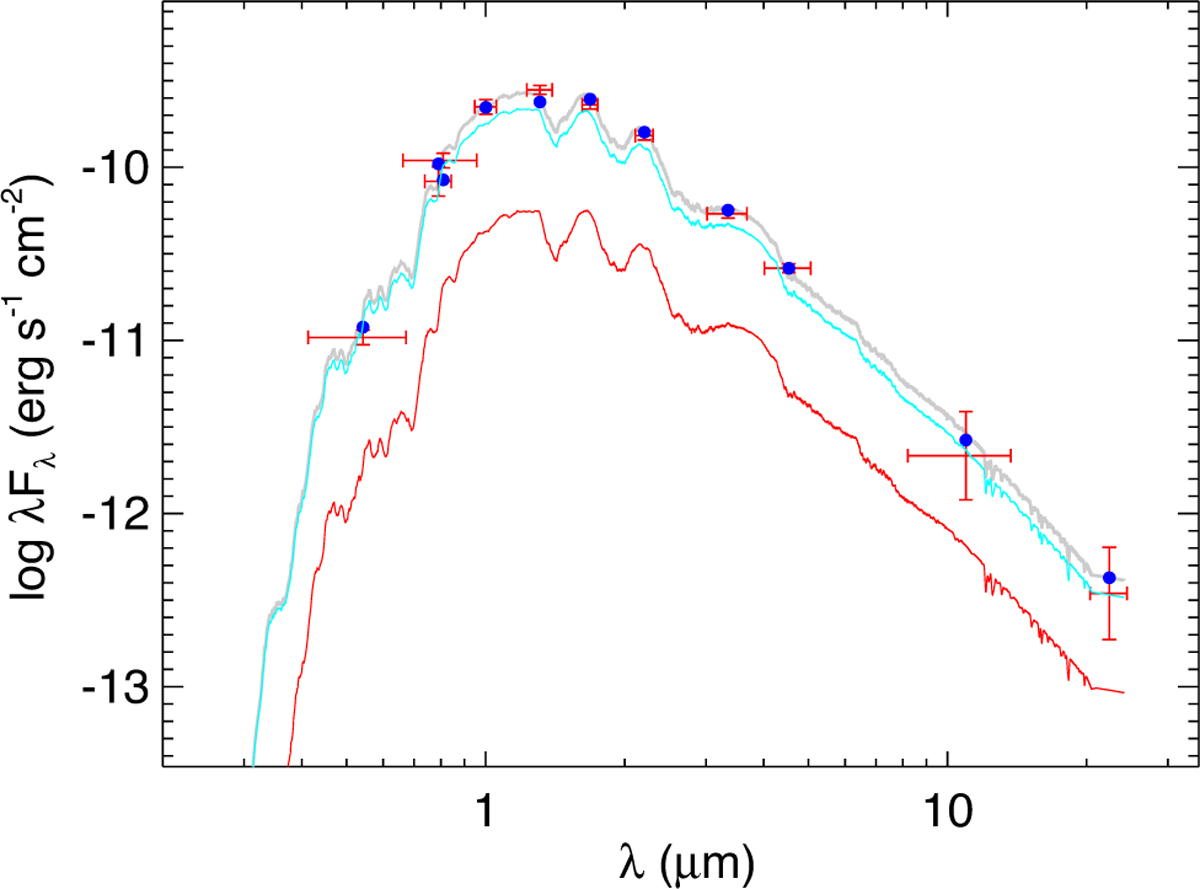
Fig. 1
Spectral energy distribution of TOI-2267. Red symbols represent the observed photometric measurements, where the horizontal bars represent the effective width of the passband. Blue symbols are the model fluxes from the best-fit NextGen stellar atmosphere model for the two stellar components (hot component in blue, cool component in red, combined light in black).