Semler, E. M., Michell, D. L., Kingsley, P. J., Ramirez, M. A., Massick, C., Castleberry, M., Doran, A. C., Carr, J. J., Marnett, L., Sheng, Q., Linton, M. F., & Vickers, K. C. (2026).听.听Atherosclerosis,听412, 120584.听
Chemical modifications on RNA, called聽epitranscriptomic modifications, help control how RNA works in our cells. Small RNA fragments, known as聽tRNA-derived fragments (tDRs), can carry these modifications from their parent RNA. Some of these modified RNAs travel through the blood inside聽high-density lipoproteins (HDL), the same particles that carry 鈥済ood cholesterol.鈥� These HDL-associated RNAs (HDL-sRNAs) can influence聽immune responses聽and may play a role in聽atherosclerotic cardiovascular disease (ASCVD).
In this study, we compared HDL-sRNAs from healthy people and patients with advanced ASCVD. Using methods like聽LC-MS/MS,听ARM-seq, and聽qPCR, we found that HDL from ASCVD patients had more RNA modifications. We identified a specific fragment,听tDR-ArgACG, carrying a modification called聽1-methyladenosine (m1A), which was more common in ASCVD. When these modified RNAs entered聽macrophages, immune cells that drive inflammation in arteries, they changed gene activity, including increasing聽TMEM123, a protein that helps immune cells move and stick to tissues. Experiments showed that HDL carrying m1A-tDR-ArgACG boosted TMEM123 in macrophages, and blocking the m1A modification reduced this effect.
These findings suggest that HDL can deliver modified RNAs to immune cells, triggering聽inflammation聽in atherosclerotic plaques. This reveals a new way that HDL-sRNAs may contribute to cardiovascular disease and points to potential targets for therapy.
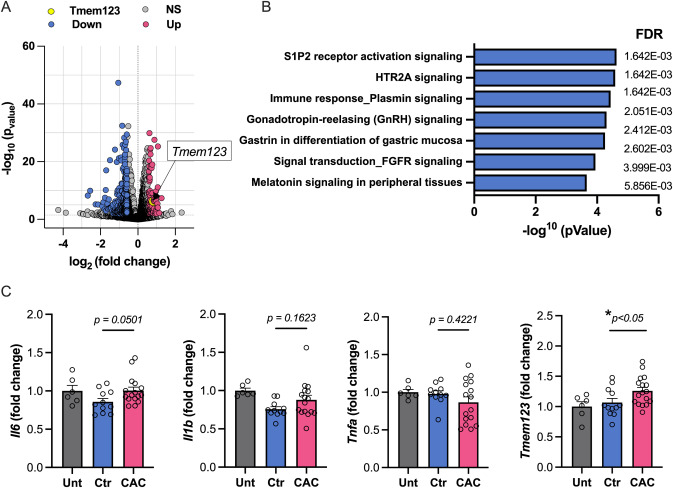
Fig. 1聽CAC聽HDL induces non-classical activation and select immune response pathway and gene expression changes in macrophages聽(A) Volcano plot depicting log10 p-adjusted (Q)-value versus log2 fold changes for all differentially expressed (鈮�2.0 absolute fold change) genes in BMDM’s treated with CAC聽+聽HDL or Ctr-HDL (n聽=聽3). (B) EGR1-containing gene set pathway analyses (Meta Core) enrichment, ranked by -log10(p-value) with false discovery rate (FDR) shown. (C) mRNA expression by qPCR displaying fold change from BMDMs treated with Ctr-HDL (n聽=聽9) and CAC+HDL (n聽=聽14). Statistical analysis assessed by Mann-Whitney聽U聽test. Data are presented as mean聽+s.e.m., 鈭�辫听&濒迟;听0.05.